
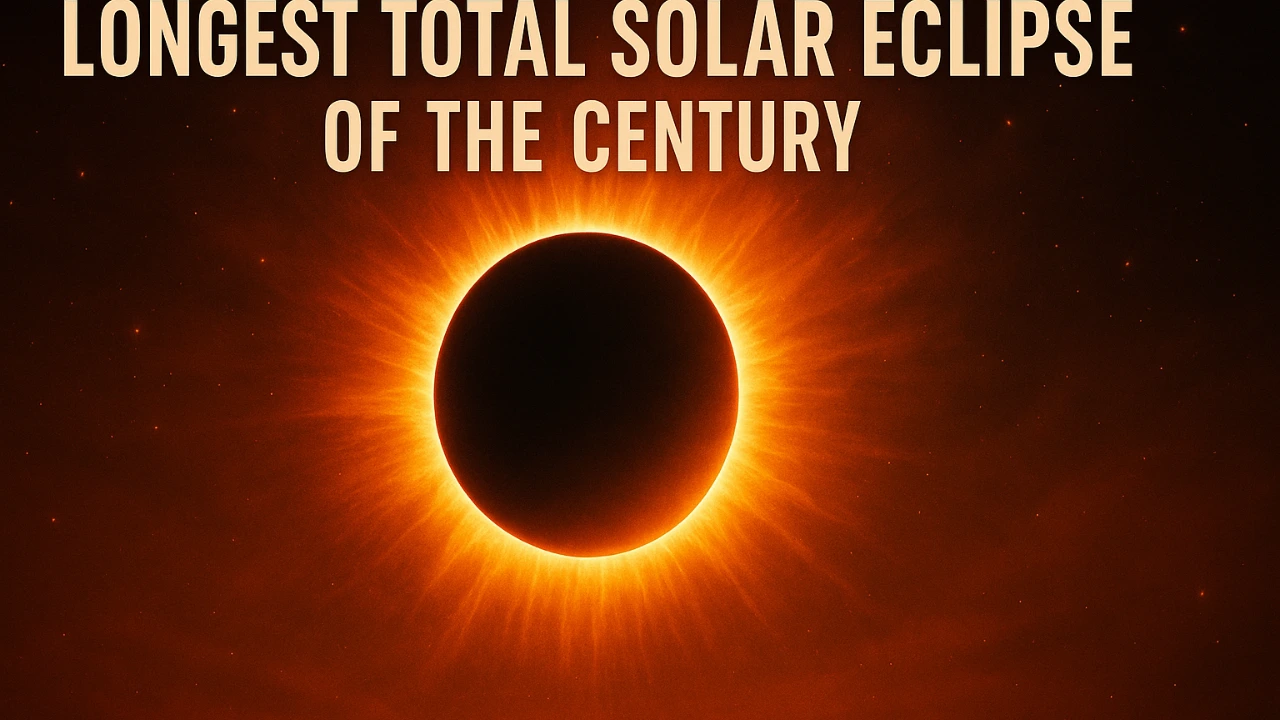
An astronomical event of extraordinary magnitude is already capturing attention across the globe: the total solar eclipse expected on August 2, 2027. Known widely as the “Eclipse of the Century,” the phenomenon will plunge parts of North Africa and the Middle East into prolonged darkness in the middle of the day, creating one of the most dramatic natural spectacles visible from Earth.
Although the United States will not be inside the path of totality, the country’s scientific community, tourism operators, and space agencies are deeply involved. American astronomers describe the event as the most significant solar eclipse opportunity in their careers, with its unusually long duration and scientifically ideal conditions offering unprecedented research potential.
Travel companies across the U.S. are already marketing international eclipse tours, and science institutions are preparing to send teams abroad to capture data that may not be possible again for decades.
Why This Eclipse Stands Out
What truly sets the August 2027 eclipse apart is its duration. Totality—the period during which the Moon completely blocks the Sun—will last up to six minutes and twenty-three seconds near its peak. For comparison, the total solar eclipse over North America in 2024 produced a maximum totality of just over four minutes.
This extreme length is the product of a rare set of cosmic conditions:
-
Earth will be near aphelion, its farthest distance from the Sun, making the Sun appear fractionally smaller in the sky.
-
The Moon will be near perigee, its closest point to Earth, causing it to appear slightly larger.
-
The resulting geometry gives the Moon a wider shadow and allows totality to linger longer than usual.
Such a combination occurs only a handful of times in a millennium, placing the 2027 eclipse into a category of its own.
A Path Crossing Eleven Countries
The path of totality, roughly 160 miles wide, will cross an expansive swath of Earth. It begins over the Atlantic Ocean before touching land at the southern edge of Spain and Gibraltar. From there, the shadow sweeps across the northern edge of the African continent, covering Morocco, Algeria, Tunisia, Libya, and Egypt. After crossing the Red Sea, totality reaches Sudan, Saudi Arabia, and Yemen before ending over Somalia and the British Indian Ocean Territory.
For many of these regions—especially Egypt, Libya, and Saudi Arabia—weather conditions in August provide near-guaranteed clear skies, making the eclipse particularly reliable for observers and scientists.
Luxor, Egypt: The Global Center of Totality
The ancient city of Luxor in Egypt is already emerging as the most coveted viewing location on Earth. Positioned almost exactly on the line of maximum totality, Luxor is expected to experience over six minutes and twenty seconds of near-darkness.
The city’s combination of clear desert skies, open landscapes, and internationally recognized archaeological sites makes it uniquely appealing. Hotels, Nile river cruises, and tour operators are reporting record-early bookings, with many accommodations already sold out more than a year in advance.
The experience is expected to blend astronomy with Egypt’s deep historical identity—an intersection few locations can match.
A Golden Opportunity for Scientists
For solar researchers, the 2027 eclipse is comparable to an unrepeatable experiment. A total solar eclipse is the only time when the Sun’s corona—the intensely hot but faint outer atmosphere—can be seen from Earth without special equipment. The corona is key to understanding solar storms, space weather, and energy flows from the Sun.
Because the eclipse offers an exceptionally long “observing window,” scientists will be able to collect far more detailed data than during typical two- to three-minute eclipses.
Research teams have identified several goals:
Coronal Dynamics
By observing the corona for more than six minutes, scientists hope to track how plasma streams and magnetic structures shift in real time around the Sun.
Solar Flares and Coronal Mass Ejections
A longer totality increases the chance of witnessing eruptive events that influence space weather and can disrupt power grids, satellites, and communications systems on Earth.
Earth’s Ionospheric Response
The abrupt loss of sunlight during an eclipse temporarily alters the ionosphere. Precise measurements of how quickly it cools and reforms could improve atmospheric and climate studies.
Calibration of Space Instruments
Missions such as NASA’s Parker Solar Probe and the European Space Agency’s Solar Orbiter rely on ground-truth data to refine their own measurements. The 2027 eclipse serves as a rare calibration window.
Biological Research
Animal behavior studies during eclipses have previously observed confusion, sudden stillness, and nocturnal patterns. The extended period of darkness offers expanded opportunities to study wildlife response.
Massive Economic Impact Forecasted Across Regions
Tourism economists are calling the event one of the largest single-day travel booms outside major sporting events like the World Cup. The 2024 North American eclipse generated an estimated six billion dollars in economic activity across the United States. Observers expect the 2027 event to surpass that figure globally because of its path across multiple countries with tourism-heavy industries.
Hotel reservations in cities near totality are already surging, with rates skyrocketing in locations like Luxor, Tangier, Djerba, and Jeddah. Cruises along the Mediterranean and the Red Sea are designing itineraries specifically to place travelers beneath the Moon’s shadow.
Anticipated Regional Economic Impact
| Region | Primary Sector Impact | Key Economic Indicators |
|---|---|---|
| North Africa (Egypt, Morocco, Tunisia) | Hospitality, travel, local retail | Record-high bookings, premium room pricing, increased sales of food, fuel, and merchandise |
| Middle East (Saudi Arabia, Yemen) | Luxury tourism, cruise travel, transport | Surge in high-end tour packages, increased air traffic, new chartered routes |
| Spain and Gibraltar | Short-term tourism | Elevated hotel and ferry traffic; day-trip visitors expected |
| Coastal and desert communities | Local commerce | Strong demand for eclipse glasses, souvenirs, and guided viewing experiences |
Many governments are preparing temporary infrastructure upgrades including mobile medical units, additional transit routes, and crowd-management systems. Experts see this as a rare opportunity for regional economic branding on a global scale.
The Four Distinct Stages of a Total Solar Eclipse
The visual and emotional progression of a total solar eclipse makes it one of nature’s most powerful experiences. Observers standing within the path of totality will witness four major stages:
Partial Phase Begins
The Moon first moves across the Sun’s disk, creating a visible indentation. This phase lasts more than an hour and requires proper eye protection.
Approach to Totality
As the Sun becomes a thin crescent, beads of light appear on the Moon’s edge. These are known as Baily’s Beads. Just before totality, the final bead creates the iconic Diamond Ring effect.
Totality
Daylight collapses into a deep twilight. Stars and planets become visible. The Sun’s corona forms a glowing white halo around the darkened Moon. Observers can safely look at the Sun only during this period.
Return to Light
The Diamond Ring reappears on the opposite side, signaling the end of totality. The Sun brightens again as the Moon moves away, and the partial phase continues until normal daylight returns.
A Cosmic Coincidence That Will Not Last Forever
Total solar eclipses are possible only because the Sun and Moon appear nearly the same size in Earth’s sky. The Sun is about four hundred times larger than the Moon, but also about four hundred times farther away. This alignment allows the Moon to perfectly cover the Sun’s bright disk.
However, the Moon is gradually moving away from Earth by a few centimeters each year. Millions of years from now, total eclipses will no longer occur—only annular eclipses, where a ring of sunlight remains visible around the Moon.
The 2027 total eclipse is a reminder of how temporary and delicate this cosmic geometry truly is.
A Global Effort to Prepare
NASA, the European Space Agency, universities, observatories, and tourism boards across eleven nations are coordinating efforts to optimize scientific research and safely manage the expected crowds.
Events, festivals, museum programs, and international collaborations are already being announced. Many U.S. institutions plan to livestream the eclipse for audiences who cannot travel.
Safety First
The most important public guidance remains simple:
-
Never look directly at the Sun without certified eclipse glasses during partial phases.
-
Only during totality is it safe to view the Sun with the naked eye.
-
Avoid counterfeit eclipse glasses by purchasing from trusted vendors.
A Moment That Will Unite the World Under One Shadow
As August 2, 2027 approaches, anticipation continues to build. The eclipse promises an extraordinary fusion of science, culture, history, and global curiosity. For a few minutes, millions of people across continents will pause to watch the day fall into darkness—an ancient, universal experience that transcends borders.
The “Eclipse of the Century” may not shine directly over the United States, but its scientific value, economic impact, and cultural influence will be felt worldwide. A celestial show of this magnitude reminds humanity of its place in the cosmos and the rare moments when the universe puts on a performance unlike any other.





Leave a Comment